Maria watched me from her garden gate for a good five minutes before she finally spoke. I was wrestling with a too-small baking dish, trying to fit what felt like an ocean of stuffing into it for a Friendsgiving that was rapidly approaching. She just shook her head, disappeared into her kitchen, and came back holding a greasy, well-loved recipe card. “You’re doing it all wrong,” she said, not unkindly. “You roll it into balls. Then everyone gets the crispy part.”
That moment changed my entire approach to holiday sides. I mean, here was this woman who had been making Thanksgiving dinner for her extended family for forty years, and she was telling me the secret was to stop treating stuffing like a side dish and start treating it like an appetizer that steals the show. Honestly, I was skeptical at first. Stuffing balls? It sounded like something from a 1970s potluck cookbook. But let me tell you, that first batch of sausage stuffing balls with apple and sage came out of the oven looking like golden, savory cookies of pure joy.
Maria’s recipe was simple—ground pork sausage, day-old bread, fresh sage from her garden, and a single Granny Smith apple that she insisted on grating rather than chopping. “The apple disappears,” she told me, “but it leaves behind this little sweetness that wakes everything up.” She was right. The first time I made them for a proper dinner party, my friend Dave, who swears he hates stuffing, ate seven of them before I could get them to the table. Seven. I had to hide the last few just so I could photograph them for my blog.
Maybe you’ve been there—standing over a pan of soggy stuffing, wondering why it never turns out as good as your grandmother’s. That’s the thing about these sausage stuffing balls with apple and sage. They solve every problem traditional stuffing has. No more fighting over the crispy corner pieces. No more mushy middle. No more wondering if you’ve made enough. These little golden spheres deliver that perfect crunchy-on-the-outside, tender-on-the-inside texture in every single bite. And they do it while making your kitchen smell like the best Thanksgiving you’ve ever had.
Why You’ll Love This Recipe
Let me share why these sausage stuffing balls have become my most-requested recipe for every gathering. I’ve tested this recipe at least a dozen times, tweaking the ratios until my family staged a friendly intervention and begged me to stop changing it. Here’s what makes them special:
- Perfect for Hosting: You can prep these entirely in advance and bake them while guests are arriving. Your oven does the work while you pour the wine and look like a culinary genius.
- Simple Ingredients: Nothing fancy here. Day-old bread, breakfast sausage, an apple, fresh sage, and basic pantry staples. You probably already have most of these in your kitchen.
- Crowd-Pleaser Guaranteed: I’ve served these at Thanksgiving, Christmas brunch, Super Bowl parties, and casual weeknight dinners. They disappear every single time, even from people who claim they “don’t like stuffing.”
- No More Soggy Stuffing: Rolling the mixture into balls means maximum surface area for browning. Every piece gets that coveted crispy exterior while staying moist and flavorful inside.
- Make-Ahead Magic: You can assemble these three days ahead and keep them in the fridge, or freeze them for up to three months. This is a lifesaver when you’re hosting a big meal.
What sets this recipe apart from every other stuffing ball recipe out there is the apple. Most recipes use apple just for sweetness, but grating it instead of chopping means it melts into the sausage mixture, adding moisture and a subtle fruity note that complements the sage without screaming “there’s fruit in here.” It’s the kind of detail that makes guests close their eyes on the first bite and ask, “What did you put in these?”
These sausage stuffing balls with apple and sage are comfort food at its finest—familiar enough to feel like home, but clever enough to impress your most food-savvy friends. They’re the dish that makes you look like you spent all day in the kitchen when really, you just rolled some balls and threw them in the oven.
What Ingredients You Will Need
This recipe uses simple, wholesome ingredients that come together to create something truly special. The magic is in how they work together, not in fancy or hard-to-find components. Most of these are pantry staples or easy to find at any grocery store.
- 1 pound ground pork breakfast sausage – I prefer Jimmy Dean’s regular or mild sausage for its perfect balance of fat and seasoning. If you use hot sausage, you’ll get a nice kick that pairs beautifully with the apple. Avoid sage-flavored sausage here since we’re adding fresh sage separately—you want the flavors to layer, not compete.
- 4 cups day-old bread cubes – About half a loaf of French bread or sourdough, cut into 1/2-inch cubes. Day-old bread is crucial here; fresh bread will turn your stuffing balls into glue. If you only have fresh bread, spread the cubes on a baking sheet and toast them at 300°F for 10 minutes to dry them out.
- 1 medium Granny Smith apple, peeled and grated – The tartness of Granny Smith is perfect here. It holds its shape during baking and provides that subtle brightness without turning mushy. Grate it on the large holes of a box grater right before mixing to prevent browning.
- 1/2 cup finely diced yellow onion – About half a medium onion. Yellow onion gives the best savory backbone, but sweet onion works in a pinch. Dice it finely so it distributes evenly throughout the mixture.
- 1/2 cup finely diced celery – About 2 stalks. Celery adds that classic stuffing crunch and freshness. Dice it the same size as the onion for even cooking.
- 2 tablespoons fresh sage, finely chopped – Fresh sage is non-negotiable here. Dried sage has a different, more medicinal flavor. You’ll find fresh sage in the produce section near the other fresh herbs. One bunch yields about 2 tablespoons of chopped leaves.
- 1 teaspoon fresh thyme leaves – Just strip the leaves from about 4 sprigs of fresh thyme. If you only have dried, use 1/2 teaspoon.
- 1/2 teaspoon salt – I use kosher salt. If you’re using table salt, reduce to 1/4 teaspoon since table salt is more concentrated.
- 1/2 teaspoon black pepper – Freshly ground is always better. It makes a real difference in the final flavor.
- 1/4 teaspoon garlic powder – Not garlic salt. Garlic powder adds a gentle background note without overwhelming the sage and apple.
- 1 large egg, lightly beaten – The egg acts as a binder, holding everything together so your stuffing balls don’t crumble. Make sure it’s lightly beaten, not foamy.
- 1/4 cup unsalted butter, melted – Plus a little extra for greasing the baking sheet. The melted butter adds richness and helps the balls brown beautifully.
- 1/2 cup low-sodium chicken broth – This adds moisture without making the mixture soggy. Low-sodium is important because the sausage already brings plenty of salt.
Equipment Needed
You don’t need any fancy equipment for these sausage stuffing balls with apple and sage. Here’s what you’ll need:
- Large mixing bowl – Big enough to get your hands in there and mix everything together. I use my grandmother’s old ceramic bowl, but any large bowl works.
- Box grater – For grating the apple. A microplane works too, but the box grater gives you the perfect texture that disappears into the mixture.
- Sharp knife and cutting board – For dicing the onion and celery, and chopping the fresh herbs.
- Measuring cups and spoons – Precision matters here, especially with the salt and broth.
- Baking sheet – A rimmed baking sheet works best to catch any drips. Line it with parchment paper for easy cleanup.
- Cookie scoop or tablespoon – A 2-tablespoon cookie scoop makes perfectly uniform balls. If you don’t have one, just use a regular tablespoon and your hands.
- Parchment paper – Optional but highly recommended. It prevents sticking and makes cleanup a breeze.
- Cooling rack – Placing the baked balls on a cooling rack keeps them from getting soggy on the bottom. If you don’t have one, transfer them to a plate lined with paper towels.
I’ve made these with both a cookie scoop and just my hands, and honestly, the scoop is worth the ten-dollar investment if you make these regularly. It gives you perfectly even balls that all cook at the same rate.
Preparation Method
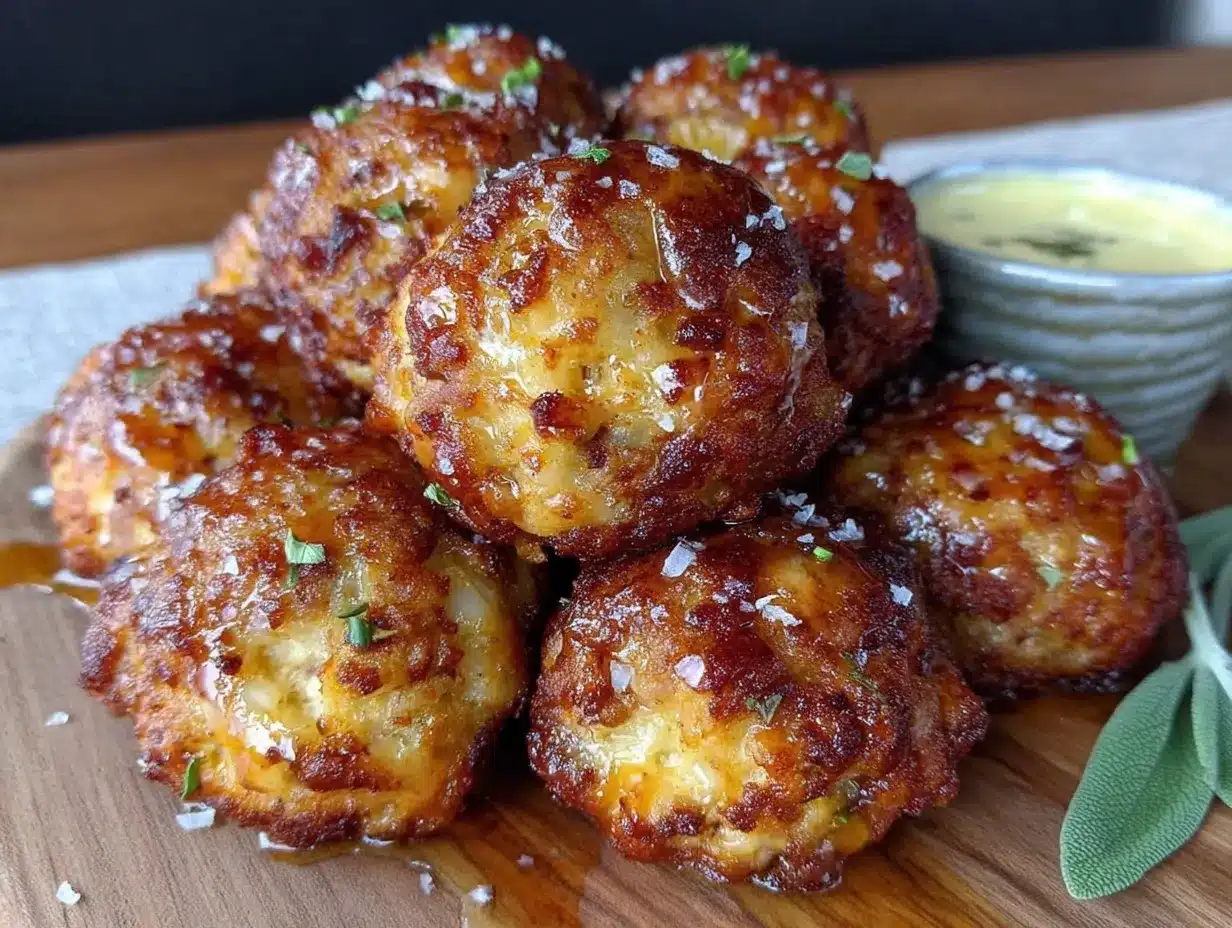
Making these sausage stuffing balls with apple and sage is surprisingly straightforward. The key is to work efficiently and trust the process. Here’s exactly how I do it:
- Preheat your oven to 375°F (190°C). Position the rack in the center of the oven. While it’s heating, line a rimmed baking sheet with parchment paper and lightly brush it with melted butter. This prevents sticking and helps the bottoms brown.
- Prepare your bread cubes if you haven’t already. Cut day-old French bread or sourdough into 1/2-inch cubes. You should have about 4 cups. If your bread is fresh, spread the cubes on a baking sheet and toast at 300°F for 8-10 minutes, stirring once halfway through. Let them cool completely before using.
- Grate the apple using the large holes of a box grater. You want the apple to be almost a paste. Squeeze the grated apple gently over the sink to remove excess moisture—you don’t want watery stuffing balls. Set it aside.
- In a large skillet over medium heat, cook the ground sausage, breaking it up with a wooden spoon as it browns. Cook until no longer pink, about 5-7 minutes. Don’t drain the fat—that’s flavor and moisture you want to keep. Remove from heat and let it cool for 5 minutes.
- In your large mixing bowl, combine the cooled sausage, bread cubes, grated apple, diced onion, diced celery, fresh sage, fresh thyme, salt, pepper, and garlic powder. Toss everything together with your hands until the ingredients are evenly distributed. Your hands really are the best tool here—they ensure everything is mixed without crushing the bread cubes.
- In a small bowl, whisk together the beaten egg, melted butter, and chicken broth. Pour this mixture over the sausage and bread mixture. Use your hands to gently combine everything until the bread cubes are evenly moistened but not soggy. The mixture should hold together when you squeeze a handful—if it’s too dry, add another tablespoon of broth; if it’s too wet, add a few more bread cubes.
- Let the mixture rest for 10 minutes. This is crucial. The bread needs time to absorb the liquid, and the flavors need a moment to get acquainted. Use this time to wash your hands and clean up your workspace.
- Form the balls using a 2-tablespoon cookie scoop or your hands. Roll each portion into a smooth ball, about 1.5 inches in diameter. Place them on the prepared baking sheet, spacing them about 1 inch apart. You should get about 24 balls from this recipe.
- Bake for 20-25 minutes, rotating the baking sheet halfway through. The balls are done when they’re golden brown on the outside and reach an internal temperature of 165°F (74°C). A thermometer inserted into the center of a ball should read this temperature.
- Let them rest on the baking sheet for 5 minutes before transferring to a serving platter. This allows them to set up and makes them easier to handle. Serve warm or at room temperature.
A quick note: Don’t overmix the stuffing ball mixture. You want the bread cubes to stay intact, not break down into crumbs. Think of it as gently combining, not aggressively mixing. Your goal is a cohesive mixture where you can still see distinct pieces of bread.
Cooking Tips & Techniques
After making these sausage stuffing balls with apple and sage more times than I care to count, I’ve learned a few things the hard way. Let me save you some trouble:
Don’t skip the resting time. I know it’s tempting to rush, but that 10-minute rest after mixing is non-negotiable. The first time I made these, I skipped it because I was in a hurry, and the balls fell apart in the oven. The bread needs time to absorb the liquid and soften, which creates the structure that holds everything together.
Use a cookie scoop for consistent sizing. Uniform balls mean even cooking. If you’re using your hands, try to make them all the same size. I’ve had batches where some were too small and dried out, while others were too large and stayed raw in the center. A 2-tablespoon scoop solves this instantly.
Watch the internal temperature. The sausage needs to reach 165°F to be safe, but don’t let them go much beyond that or they’ll dry out. I use an instant-read thermometer and start checking at 20 minutes. Once they hit 160°F, I watch them closely—they’ll climb the last 5 degrees while resting.
Make extra for the freezer. These freeze beautifully. I always make a double batch and freeze half on a baking sheet, then transfer to a freezer bag once solid. To reheat, just pop them frozen onto a baking sheet and bake at 350°F for 15 minutes. They taste just as good as fresh.
Toast your bread cubes properly. If you’re using fresh bread, don’t skip the toasting step. I learned this the hard way when I made a batch with fresh bread and ended up with stuffing balls that were gummy in the center. Toasting dries out the bread so it can absorb the liquid without turning to mush.
Variations & Adaptations
These sausage stuffing balls are incredibly versatile. Here are some variations I’ve tried and loved:
Make it vegetarian: Substitute the pork sausage with a plant-based breakfast sausage crumble. Add an extra tablespoon of butter and a splash of liquid smoke to compensate for the missing pork fat. My vegetarian sister-in-law requests this version every Thanksgiving.
Add dried fruit: Fold in 1/2 cup of dried cranberries or chopped dried apricots along with the bread cubes. The tartness of cranberries pairs beautifully with the sage, and apricots add a lovely chewy texture. This is my favorite variation for Christmas dinner.
Go gluten-free: Use gluten-free bread cubes. Gluten-free bread is often drier than regular bread, so you might need to add an extra tablespoon or two of broth. I recommend Udi’s or Canyon Bakehouse for best results.
Spice it up: Use hot breakfast sausage instead of mild, or add 1/2 teaspoon of red pepper flakes along with the other seasonings. This version is perfect for game day gatherings.
Make it dairy-free: Substitute the butter with olive oil or a plant-based butter alternative. The texture will be slightly different, but still delicious. I’ve used Miyoko’s vegan butter with great results.
Add nuts for crunch: Fold in 1/2 cup of toasted pecans or walnuts along with the bread cubes. Toast them first in a dry skillet over medium heat for 3-4 minutes until fragrant. This adds a wonderful crunch that contrasts with the soft interior.
Serving & Storage Suggestions
These sausage stuffing balls with apple and sage are incredibly versatile when it comes to serving. Here’s how I handle them:
Serving temperature: Serve them warm, straight from the oven. They’re at their best within 15 minutes of baking, when the exterior is still crispy and the interior is hot and tender. That said, they’re also delicious at room temperature—I’ve eaten more than a few cold ones straight from the fridge the next morning.
Presentation tips for hosting: Arrange them on a large wooden board or a white platter for maximum visual impact. Garnish with fresh sage leaves and a sprinkle of flaky sea salt. For holiday gatherings, I sometimes drizzle them with a balsamic glaze or serve them with a side of cranberry sauce for dipping.
What to serve alongside: These are perfect with roasted turkey or chicken, but they also shine alongside a simple green salad, roasted vegetables, or even as a breakfast side with eggs. For a complete holiday spread, pair them with creamy mashed potatoes and quick cranberry sauce.
Storage instructions: Store leftover stuffing balls in an airtight container in the refrigerator for up to 4 days. To reheat, place them on a baking sheet and warm in a 350°F oven for 8-10 minutes. The microwave works in a pinch, but the oven restores much of the original texture.
Freezing instructions: Freeze unbaked or baked stuffing balls. For unbaked, form the balls and place them on a parchment-lined baking sheet. Freeze until solid, then transfer to a freezer bag. Bake from frozen, adding 10 minutes to the cooking time. For baked, cool completely, then freeze in a single layer before bagging.
How flavors develop: Honestly, these taste even better the next day. The flavors meld together overnight, and the texture softens slightly. If you’re making them for a big meal, I actually recommend making them a day ahead and reheating just before serving. Your guests will never know they weren’t freshly baked.
Nutritional Information & Benefits
While these sausage stuffing balls with apple and sage are definitely a comfort food, they do offer some nutritional benefits worth noting:
Estimated per serving (2 balls): Calories: 285, Fat: 18g, Saturated Fat: 7g, Cholesterol: 55mg, Sodium: 520mg, Carbohydrates: 18g, Fiber: 1g, Sugar: 3g, Protein: 12g.
Health benefits: The apple provides a small dose of fiber and vitamin C, while the sage is rich in antioxidants and has anti-inflammatory properties. The chicken broth adds collagen and minerals. Using lean breakfast sausage and reducing the butter can lower the fat content if you’re watching your intake.
Dietary considerations: This recipe contains gluten (from the bread), dairy (from the butter), and eggs. For gluten-free, use gluten-free bread. For dairy-free, substitute the butter with olive oil. The recipe is naturally nut-free but can be made with nuts for added texture.
Potential allergens: Contains wheat, dairy, and eggs. Check your sausage label for additional allergens, as some brands include fillers or seasonings that may contain soy or other allergens.
My personal take: I don’t make these every day, but when I do, I savor every bite. They’re a celebration food, and that’s okay. Food is about more than just nutrition—it’s about connection, joy, and creating memories around the table.
Conclusion
These sausage stuffing balls with apple and sage have become my signature dish for every gathering, and I think they’ll become yours too. They solve every problem that traditional stuffing presents—no more fighting over crispy bits, no more soggy centers, no more last-minute oven space battles. They’re make-ahead friendly, freezer-friendly, and crowd-friendly.
What I love most about this recipe is how it honors the original while making it completely its own. Maria’s simple wisdom—that rolling stuffing into balls makes every bite the best bite—has transformed how I approach holiday cooking. And the apple? That was her secret, and now it’s yours too.
I’d love to hear how these turn out for you. Have you tried them with different add-ins? Did your family fight over the last one? Drop a comment below and let me know—I read every single one, and I love seeing your photos. If you’re looking for more holiday inspiration, don’t miss my perfect roasted turkey guide and foolproof pumpkin pie recipe.
Now go make some stuffing balls. Your guests are going to love you for it.
Frequently Asked Questions
Can I make these stuffing balls ahead of time?
Absolutely! You can assemble the balls up to three days in advance and keep them covered in the refrigerator. You can also freeze them for up to three months. Just bake them straight from the fridge or freezer, adding a few extra minutes to the cooking time.
Why did my stuffing balls fall apart?
This usually happens for one of three reasons: the mixture was too dry, the bread wasn’t dried out enough, or you skipped the resting time. Make sure your bread cubes are properly dried, let the mixture rest for 10 minutes before forming the balls, and don’t be afraid to add an extra tablespoon of broth if the mixture seems dry.
Can I use dried sage instead of fresh?
You can, but I really recommend fresh sage for this recipe. Dried sage has a more concentrated, almost medicinal flavor that can overwhelm the other ingredients. If you must use dried, use only 1 tablespoon and crumble it finely. The texture and flavor won’t be quite the same, though.
What’s the best way to reheat leftover stuffing balls?
The oven is your best friend here. Place them on a baking sheet and warm at 350°F for 8-10 minutes. This restores the crispy exterior. The microwave works in a pinch, but the texture will be softer. For frozen balls, bake at 350°F for 15-18 minutes without thawing.
Can I make these without a cookie scoop?
Of course! A cookie scoop just makes the process faster and ensures uniform sizing. You can absolutely use your hands—just wash them well and lightly wet them with water to prevent sticking. Aim for balls that are about 1.5 inches in diameter, roughly the size of a golf ball.
Pin This Recipe!
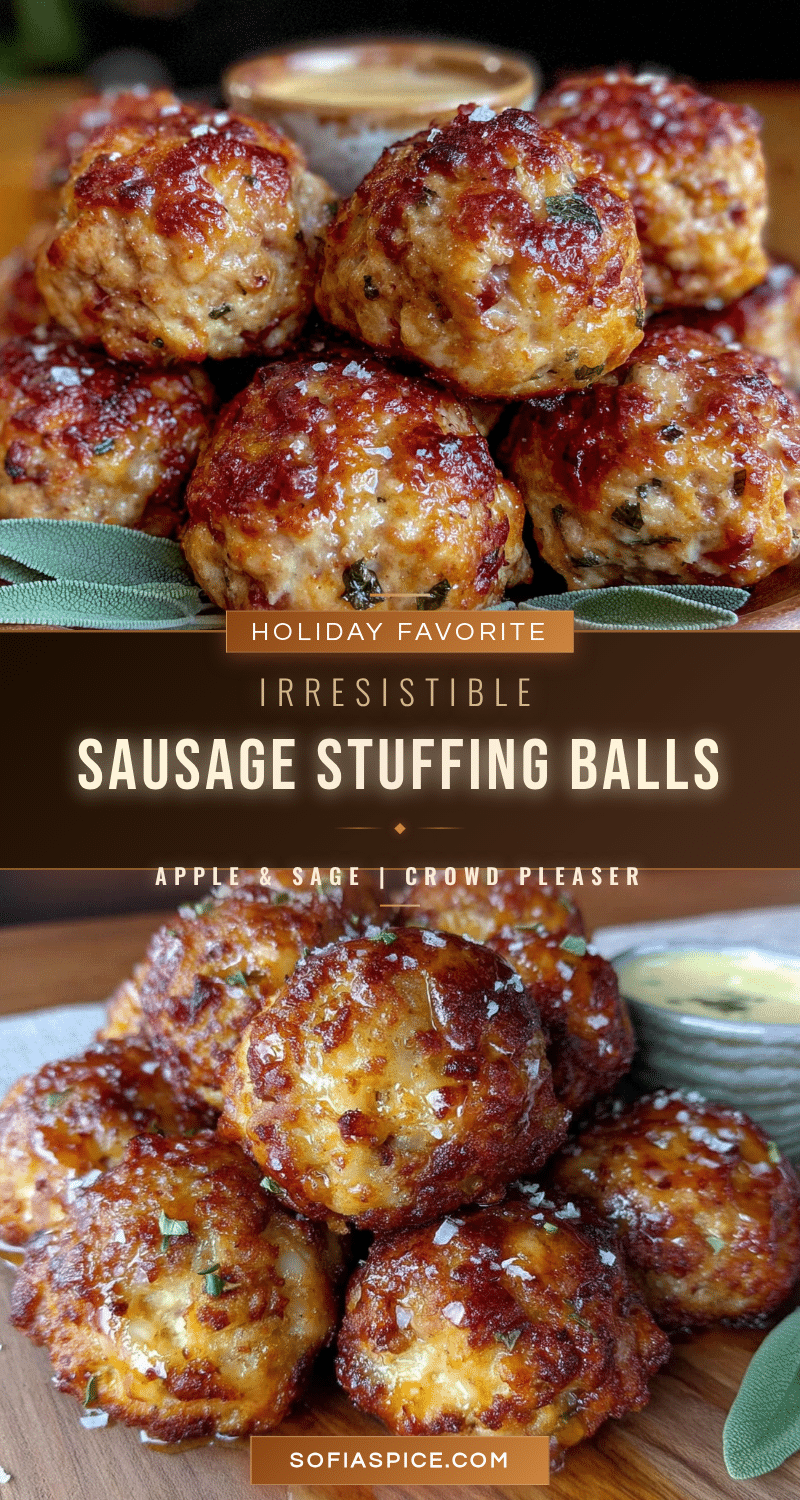
Best Homemade Sausage Stuffing Balls with Apple & Sage

These golden, savory sausage stuffing balls with apple and sage deliver a perfect crunchy-on-the-outside, tender-on-the-inside texture in every bite. A make-ahead, crowd-pleasing twist on traditional stuffing that solves the problem of soggy stuffing and fighting over crispy bits.
- Prep Time: 20 minutes
- Cook Time: 25 minutes
- Total Time: 45 minutes
- Yield: 24 balls (12 servings of 2 balls each) 1x
- Category: Appetizer / Side Dish
- Cuisine: American
Ingredients
- 1 pound ground pork breakfast sausage
- 4 cups day-old bread cubes (about 1/2 loaf French bread or sourdough, cut into 1/2-inch cubes)
- 1 medium Granny Smith apple, peeled and grated
- 1/2 cup finely diced yellow onion (about 1/2 medium onion)
- 1/2 cup finely diced celery (about 2 stalks)
- 2 tablespoons fresh sage, finely chopped
- 1 teaspoon fresh thyme leaves (or 1/2 teaspoon dried)
- 1/2 teaspoon kosher salt (or 1/4 teaspoon table salt)
- 1/2 teaspoon freshly ground black pepper
- 1/4 teaspoon garlic powder
- 1 large egg, lightly beaten
- 1/4 cup unsalted butter, melted (plus extra for greasing)
- 1/2 cup low-sodium chicken broth
Instructions
- Preheat your oven to 375°F (190°C). Position the rack in the center of the oven. Line a rimmed baking sheet with parchment paper and lightly brush it with melted butter.
- Prepare your bread cubes if you haven’t already. Cut day-old French bread or sourdough into 1/2-inch cubes (about 4 cups). If using fresh bread, spread cubes on a baking sheet and toast at 300°F for 8-10 minutes, stirring once halfway through. Let cool completely.
- Grate the apple using the large holes of a box grater. Squeeze the grated apple gently over the sink to remove excess moisture. Set aside.
- In a large skillet over medium heat, cook the ground sausage, breaking it up with a wooden spoon, until no longer pink (about 5-7 minutes). Do not drain the fat. Remove from heat and let cool for 5 minutes.
- In a large mixing bowl, combine the cooled sausage, bread cubes, grated apple, diced onion, diced celery, fresh sage, fresh thyme, salt, pepper, and garlic powder. Toss together with your hands until evenly distributed.
- In a small bowl, whisk together the beaten egg, melted butter, and chicken broth. Pour over the sausage and bread mixture. Use your hands to gently combine until bread cubes are evenly moistened but not soggy. The mixture should hold together when squeezed.
- Let the mixture rest for 10 minutes. This allows the bread to absorb the liquid and the flavors to meld.
- Form the balls using a 2-tablespoon cookie scoop or your hands. Roll each portion into a smooth ball, about 1.5 inches in diameter. Place on the prepared baking sheet, spacing about 1 inch apart. You should get about 24 balls.
- Bake for 20-25 minutes, rotating the baking sheet halfway through. The balls are done when golden brown on the outside and reach an internal temperature of 165°F (74°C).
- Let them rest on the baking sheet for 5 minutes before transferring to a serving platter. Serve warm or at room temperature.
Notes
Don’t skip the resting time after mixing—it’s crucial for structure. Use a cookie scoop for uniform sizing and even cooking. For best texture, serve within 15 minutes of baking. These can be assembled up to 3 days ahead and refrigerated, or frozen for up to 3 months. To reheat frozen balls, bake at 350°F for 15-18 minutes without thawing.
Nutrition
- Serving Size: 2 balls
- Calories: 285
- Sugar: 3
- Sodium: 520
- Fat: 18
- Saturated Fat: 7
- Carbohydrates: 18
- Fiber: 1
- Protein: 12
Keywords: sausage stuffing balls, apple sage stuffing, holiday appetizer, Thanksgiving stuffing, make-ahead stuffing, crispy stuffing balls, pork sausage stuffing